Why Floating Solar is gaining ground in the UK
7/01/2026 -
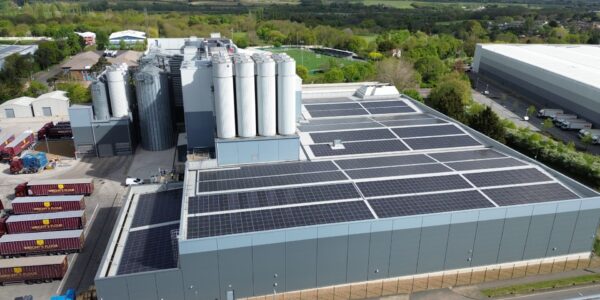
As the UK searches for new ways to expand renewable energy generation without placing further strain on land, floating solar is emerging as one of the most promising and commercially viable solutions. East Green Energy’s recent installation for Suffolk Fresh in Great Blakenham, near Ipswich, demonstrates just how far the technology has come, and why it is increasingly relevant for high‑consumption businesses.
At the end of last year, East Green Energy delivered a 750 kWp floating solar system on the site’s reservoir. Covering 3,500 m² of water and built from 1,250 high‑performance panels, the array is designed to supply around 20% of the energy needed to power the UK’s first semi‑closed hydroponic glasshouse, an 8.4‑hectare facility roughly the size of 11 football pitches. With a projected six‑year payback and an estimated 15% ROI, the project highlights the strong commercial case now underpinning floating solar.
Addressing land pressure with nnovation
For many businesses, solar power still conjures images of rooftop arrays or large ground‑mounted systems. But in regions like Suffolk, where agriculture, food production and development all compete for space, land availability is a growing challenge.
East Green Energy has seen this pressure first‑hand across the East of England. Floating solar offers a practical alternative: by using reservoirs, lagoons and other water bodies, organisations can generate clean energy without sacrificing land or disrupting operations.
For Suffolk Fresh, the approach was a natural fit. Their reservoir at Great Blakenham was a stable, under‑used asset. By installing a floating array, East Green Energy enabled the business to introduce renewable generation without affecting its glasshouse footprint or surrounding farmland.
How Floating Solar works – and why it performs
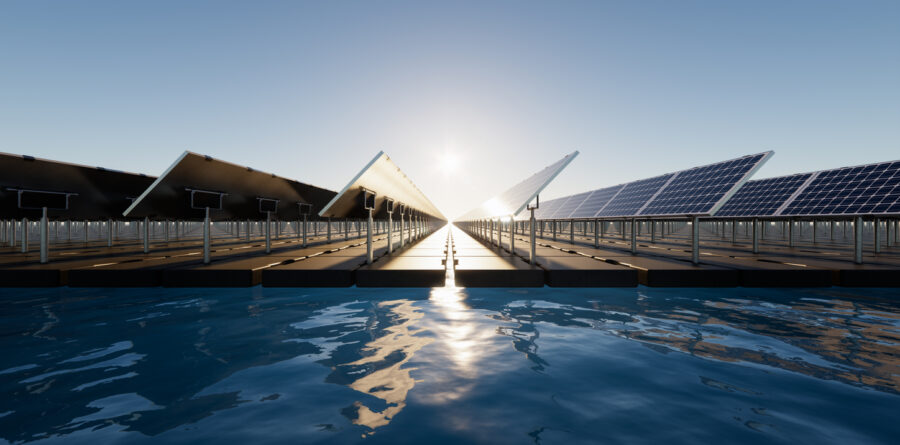
Floating solar systems sit on buoyant platforms that rise and fall with the water level. While the panels operate in the same way as any other solar installation, the water beneath them brings several performance and environmental advantages:
- Natural cooling, improving panel efficiency
- Reduced evaporation, helping conserve water resources
- No land impact, easing planning constraints
- More stable temperatures and reflective surfaces, supporting higher yields
Globally, the technology is accelerating. In 2023, the floating solar market was valued at £7.1 billion, with forecasts suggesting it could reach £32.3 billion by 2030. Falling technology costs, government support and the need for land‑efficient renewable solutions are driving rapid adoption.
Why Floating Solar makes sense for the UK
The UK has thousands of reservoirs and lagoons, many on private or industrial land, that remain largely untapped for energy generation. East Green Energy sees significant opportunity here, particularly for businesses with high energy demand and limited land availability.
Floating solar offers:
- A route to renewable generation without affecting farmland
- Higher efficiency thanks to cooler operating temperatures
- Reduced evaporation and wave action, helping protect water assets
- A practical solution for sites where planning for ground‑mounted systems is difficult
For food producers, horticulture businesses and water‑intensive industries, the technology aligns closely with operational needs and sustainability goals.
Building on the UK’s existing water infrastructure
According to the British Hydropower Association, the UK generates around 5.496 TWh of hydroelectric energy each year across 1,657 hydropower schemes. Many of these sites already have the grid infrastructure required to support further renewable generation. Even deploying floating solar on a small proportion of these water surfaces could significantly increase national output without requiring additional land.
A growing opportunity for the region
Countries such as Germany, Italy and Japan have already adopted floating solar at scale. The UK is still catching up, leaving considerable untapped potential — particularly in regions like East Anglia, where agriculture and horticulture dominate and land is at a premium.
Floating solar will not replace rooftop or ground‑mounted systems, but it is becoming an increasingly valuable option where land is constrained or water assets are already part of the site. East Green Energy expects more organisations to explore this route as the technology matures, with Suffolk Fresh’s installation offering a clear indication of what is now achievable.
To learn more about adopting floating solar technology, head to East Green Energy’s website.
All articles on this news site are submitted by registered contributors of SuffolkWire. Find out how to subscribe and submit your stories here »